Project
Hardware · biomedical
ECG acquisition system
- Altium
- Cadence
- Analog design
- PCB
The heart’s signal is tiny and buried in noise, especially 50 Hz mains hum. The challenge of this Electronics Lab final project was to recover a clean trace cheaply and in a wearable form, carried from a breadboard prototype all the way to a finished, watch-sized board.
A front end that amplifies the heart and rejects the rest
It uses an INA121 instrumentation amplifier at a gain of 500 to lift the differential signal, an active band-pass filter (roughly 0.3 to 100 Hz) to keep only the cardiac band, and a Twin-T notch filter at 50 Hz to remove power-line hum.
How do you pull a clean heartbeat out of all that noise?
Simulated, routed, soldered, and debugged
To reject common-mode noise I (along with my lab mate Muhammad Rabeh) added a Driven-Right-Leg circuit that senses the common-mode voltage and feeds an inverted copy back through the right-leg electrode, driving it toward zero. I validated the full chain in Cadence, including body-model and component-mismatch analysis, before layout.
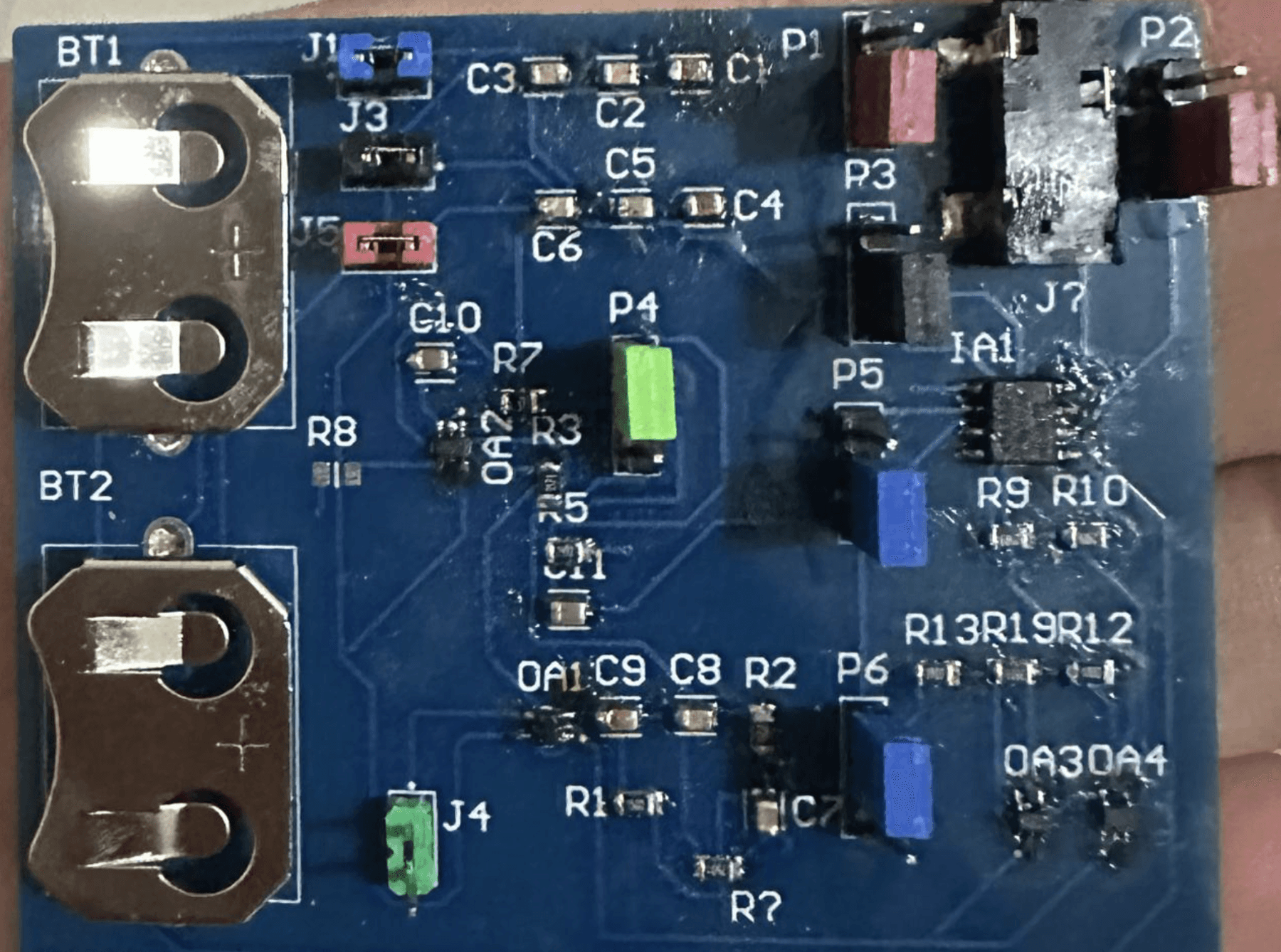
Final PCB
Then I routed a compact PCB (under 70 by 70 mm) in Altium with 0805 SMD parts, a CR2032 coin-cell supply, and an audio-jack electrode interface, hand-soldered the surface-mount components, and debugged it stage by stage until it produced a clean trace, low-cost biomedical sensing built from first principles, end to end.
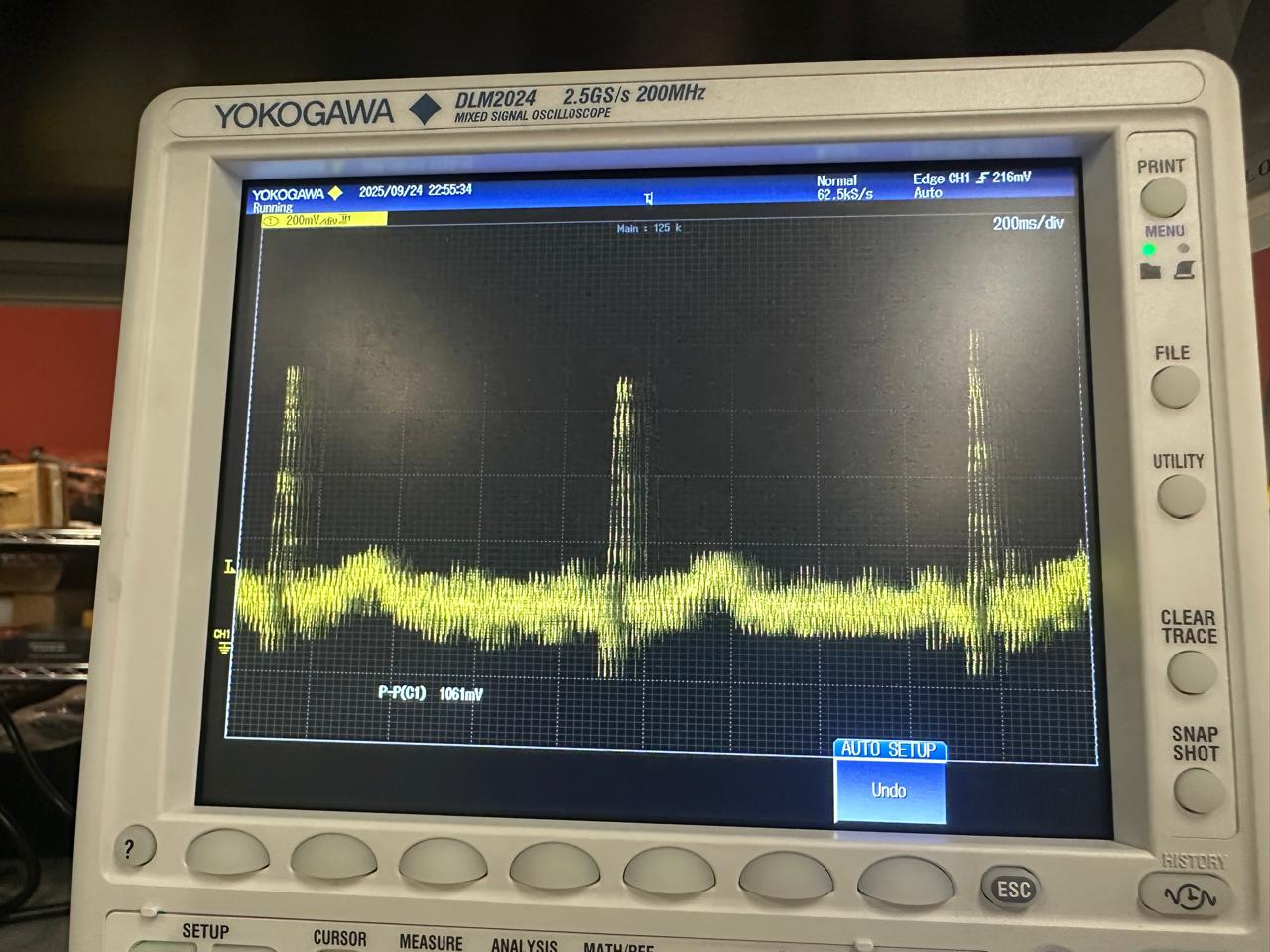
Signal capture
