Fall detection from Wi-Fi Doppler
Detecting falls from the Doppler shifts a falling body leaves in Wi-Fi signals, without training a model, and checking them against motion-capture skeletons.
- Role
- Capstone researcher
- Advisor
- Prof. Marwa Chafii, with Dr. Ahmad Bazzi
- Tools
- MATLAB
- Year
- 2026 to present
My electrical engineering capstone, supervised by Prof. Marwa Chafii with guidance from Dr. Ahmad Bazzi.
When someone falls, their body moves fast enough to shift the frequency of the Wi-Fi signals bouncing off it. It’s the same Doppler effect that changes the pitch of a passing siren. The project asks whether those shifts alone, measured with ordinary Wi-Fi hardware, are enough to tell that someone has fallen, with no camera, no wearable and no trained model.
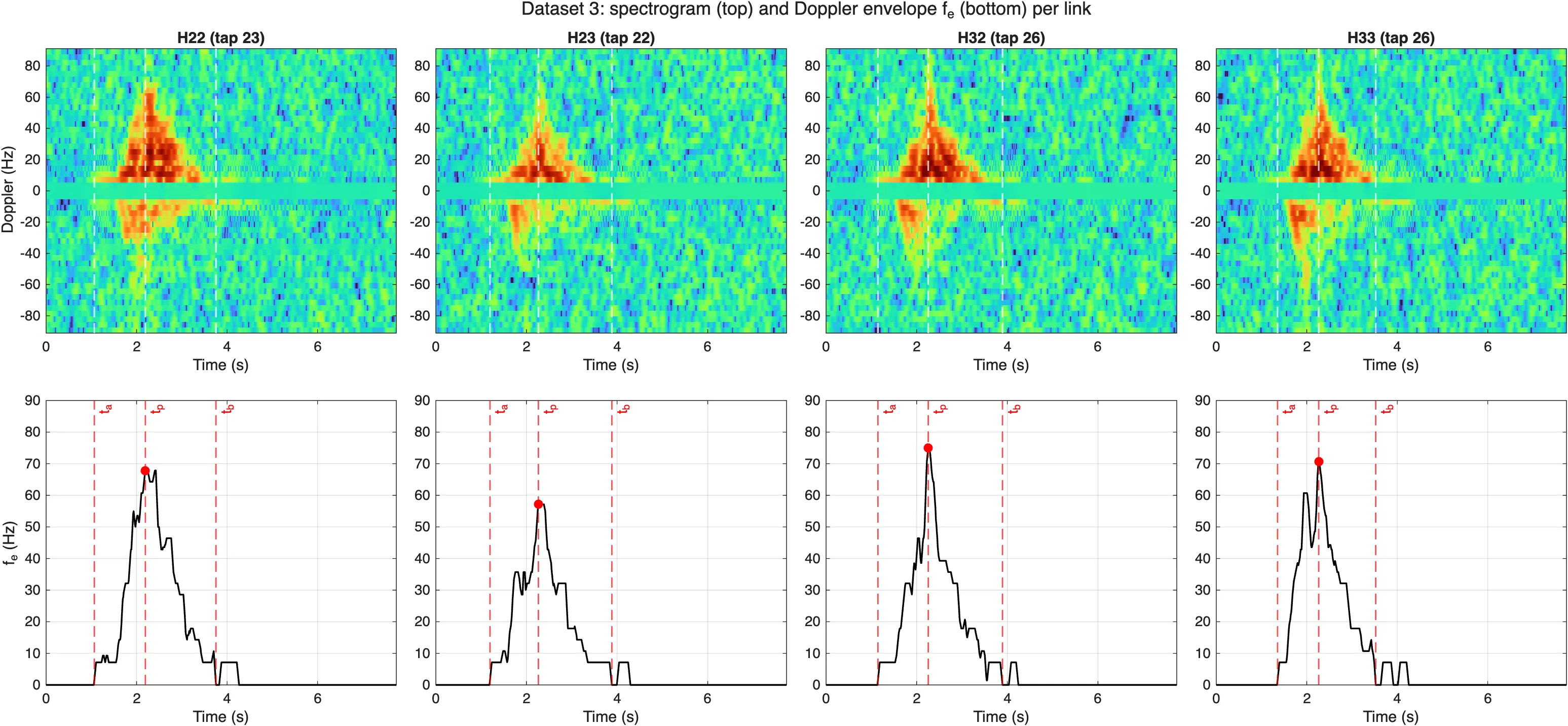
One fall seen on four Wi-Fi links. Top: Doppler spectrograms. Bottom: the Doppler envelope, with the detected start, peak and end marked.
I work with a dataset of falls recorded two ways at once: Wi-Fi channel measurements across four transmitter and receiver links, and an Azure Kinect tracking the person’s skeleton. The skeleton is the ground truth. From the body’s real motion I can predict the Doppler signature a fall should produce, then compare it with what the Wi-Fi actually measured.
One recorded fall, replayed in sync. Left: the Kinect skeleton. Middle: joint heights, joint speed and the Doppler predicted from the skeleton’s motion. Right: the Doppler measured on three Wi-Fi links.
So far I’ve built the processing pipeline in MATLAB: turning each link’s signal into a time-frequency spectrogram, aligning the Wi-Fi and skeleton recordings in time, and an event detector that marks when a fall starts, peaks and ends on each of the four links. Next is combining the links into a single detection decision.
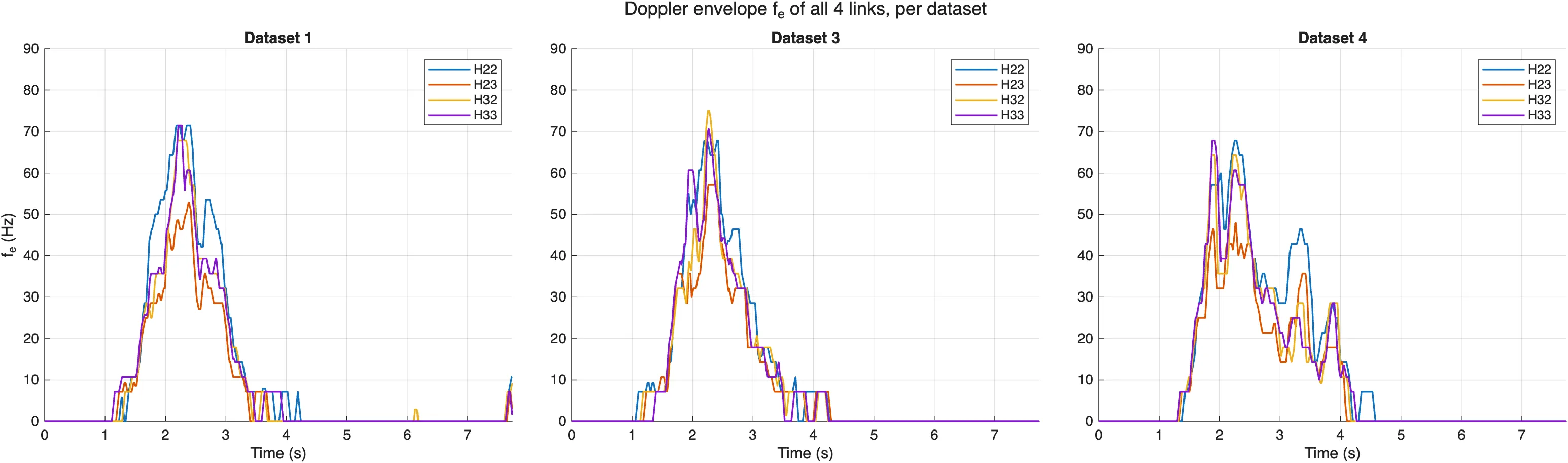
Across three recorded falls, the four links agree on when the fall happens. Combining them is the next step.
For a faster, learned take on the same problem, see FallGuard.