FallGuard: Wi-Fi fall detection
Fall detection from Wi-Fi signals, built at the Tech@NYU Shipyard hackathon. Winner of DigitalOcean Best Open-Source AI Project.
- Event
- Tech@NYU Shipyard, October 2026
- Award
- DigitalOcean Best Open-Source AI Project
- Tools
- Python, PyTorch, Snowflake, Llama 3.1 70B, Streamlit
Falls are a leading cause of injury for older adults who live alone. Cameras feel invasive at home and wearables get left on the nightstand, but almost every home already has Wi-Fi. When someone moves, they disturb the Wi-Fi signal filling the room in patterns you can recognize. FallGuard reads those disturbances to tell when someone has fallen, then gets help to them. You can tell someone fell, but not who they are.
I built it in a day at the Tech@NYU Shipyard buildathon, where it won DigitalOcean Best Open-Source AI Project.
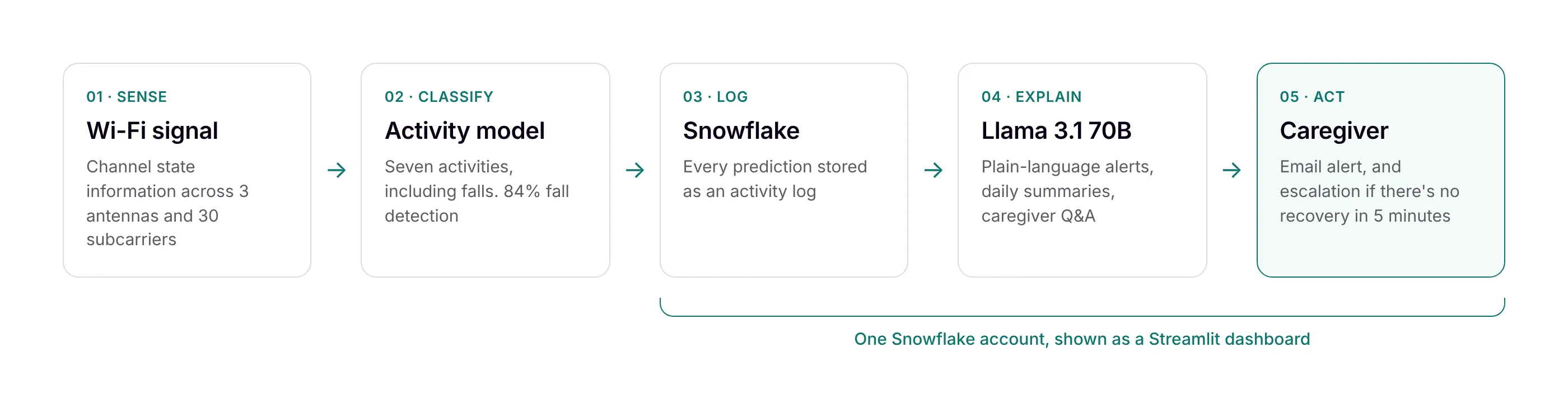
The sensing side uses Wi-Fi channel state information from the public UT-HAR dataset: how the signal changes across 3 antennas and 30 subcarriers over time. I trained a classifier that recognizes seven activities, including walking, sitting, lying down and falling. It detects falls with 84% accuracy and gets 72% across all seven.
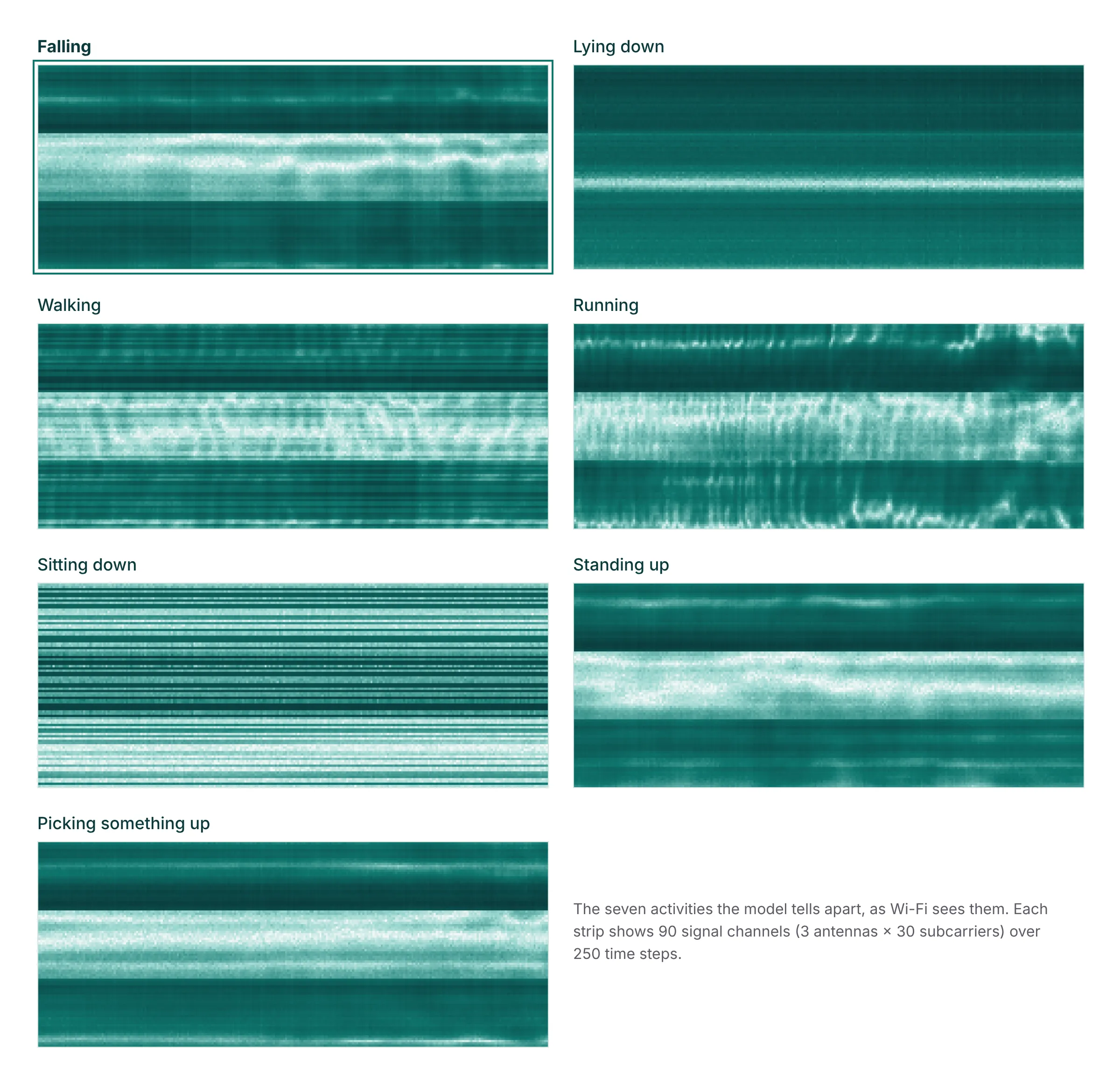
Every prediction is logged to Snowflake, where Llama 3.1 70B turns the activity log into something a caregiver can use: an alert written in plain language when a fall happens, a daily summary, and answers to questions like how long she was lying down after the fall. Alerts go out as real emails. If there’s no sign of recovery within five minutes, FallGuard escalates to an emergency call, simulated in the demo, and logs it. The whole thing runs as a Streamlit dashboard inside the same Snowflake account.
The demo replays a day built from real UT-HAR recordings, classified by the model, so it behaves like a live feed. A real deployment would stream signals from a cheap Wi-Fi chip like an ESP32. Next on the list is a voice check-in that asks “Are you okay?” before escalating.
This project grew out of my capstone, which tackles the same problem from the physics side.